From predicting words to representing meaning: what can artificial intelligence teach us about the possibility of a self?
How can a machine translate a word that does not exist in our language?
The Portuguese word saudade is often translated as “nostalgia”, but that translation leaves something out: the longing for an absent presence, emotional memory, a particular quality of missing something. The German Schadenfreude, by contrast, needs a short phrase: the pleasure felt at someone else’s misfortune.
Translating means finding an expression that can preserve the original relationships of meaning in a new context. It is a problem that concerns words, but also what words allow us to think.
This is precisely where one of the most interesting questions about artificial intelligence begins: how can a system trained through statistics learn to handle meaning? And what does this have to do with the emergence of intelligence—and, ultimately, self-awareness?
Two maps of the world
We can imagine languages as maps that divide up the world in different ways. Some regions overlap; others have different boundaries. One language concentrates in a single word what another spreads across several expressions.

It is a metaphor, but it helps explain why translation cannot be reduced to a gigantic dictionary. Choosing a good translation requires attention to context: who is speaking, whom they are addressing, what situation they are describing, and what nuance they want to convey.
In language models, words and fragments of words are processed through numerical representations. These representations change as the context is processed: the same word, placed in different sentences, can take on different roles and meanings.
Speaking of a “geometry of meaning” is therefore a way of describing relationships that a model can encode. It does not imply that the network contains an orderly atlas of concepts like one we might draw on a sheet of paper.
Multilingualism as a benefit of training
A language model is trained to predict the next fragment of text. When the data contains several languages, the same objective leads it to learn different vocabularies, grammatical structures and relationships of meaning through a shared network of parameters.
Consider two sentences: “Il gelato si scioglie al sole” and “The ice cream melts in the sun”. The words change, but the situation described is the same. Bilingual texts, translations, proper names and shared references can encourage connections between these expressions. Training can thus build representations that help process aspects of meaning in both languages.
This process can produce translation abilities even without subsequent training devoted exclusively to translation. This is the sense in which we can speak of a side benefit: to improve at predicting text, the model learns resources that can be reused in other tasks. The GPT-3 study already demonstrated translation abilities activated through instructions and examples, without updating the parameters for that task. (Brown and colleagues.) Establishing the same relationships in different linguistic corpora—subject, object, direct object, verb form and sentence structure—is what taught AI to understand languages: all the languages on which it was trained. The texts do not even have to be multilingual. Many linguistic correspondences are inferred from the structure of text, which can be reconstructed across different texts as well. The multilingualism of LLMs is therefore an interesting by-product of large-scale training.
The result nevertheless depends on the quantity and quality of data in different languages; multilingualism can also be developed intentionally. The central point remains: a statistical prediction objective can encourage representations that connect different ways of expressing meaning.
A simple objective, a complex problem
The training of many language models rests on a seemingly modest task: predicting the next token, the next unit of text, which may be a word or part of one.
Consider this sentence:
“Giulia left the ice cream on the table, near the window, on a very hot day. When she came back…”
To complete it plausibly, it helps to grasp a relationship between heat, elapsed time and the behaviour of ice cream. Grammar alone is not enough.

Of course, a correct completion does not prove that the machine understands the situation as a person does. It does show, however, why a prediction task can encourage the learning of structures richer than simple word frequencies.
One example comes from research on a model trained to predict moves in the game Othello. Researchers found evidence of an internal representation of the board state, even though they had not explicitly provided it to the model. The result concerns a constrained environment, but it makes one possibility concrete: learning to predict sequences can lead to representing the structure that generates them. (Li and colleagues, Emergent World Representations.)
How a representation emerges
During training, the network produces a prediction and receives a measure of its error. A procedure called backpropagation calculates how the network’s parameters contribute to that error; the gradient gives the parameters a direction of change to reduce the error at each level, and optimisation modifies them to improve subsequent predictions.
Repeated over large amounts of data, this process can build internal regularities that no programmer has defined one by one.
The network is organised in layers, and each layer involves a different level of meaning.
In language study, we move from syntax to grammatical analysis and the analysis of sentence roles, then to tense agreement and the analysis of complex sentences, eventually reaching the construction of sentences and paragraphs and the strategy of writing.
In our minds, this is a smooth process that, as I have written in other articles on this blog, allows us to move easily between levels. In machines, the situation is more complicated, and the levels need guidance, especially for strategic reasoning. Here, however, we have an emergent, multilevel structure arising from the hierarchical structure of deep neural networks itself.
We can use the same sentence to show how processing can move from linguistic units to relationships and inferences:
“Giulia left the ice cream near the window. The sun was strong. When she came back, she found it melted.”
These are levels of interpretation, not a rigid correspondence between functions and individual network layers.
| Level | What is represented | Example in the sentence |
|---|---|---|
| Input: tokens and position | Fragments of text transformed into numerical vectors, with information about position. | The sequence contains the fragments making up “Giulia”, “ice cream”, “window” and “melted”. |
| Lexical | Linguistic identities, associations and possible meanings of words. | “Ice cream” evokes a food and properties associated with cold; “melted” takes on a meaning consistent with that context. |
| Grammatical and syntactic | Relationships between words and the structure of sentences. | Giulia is the subject of “left”; the ice cream is the object; “near the window” indicates a position. |
| Semantic | Roles and relationships describing the situation. | A person leaves an object in a place, goes away, and later finds it in a different state. |
| References and context | Connections between different parts of the text. | “It” refers to the ice cream; “she” in “she came back” refers to Giulia, the implicit subject in the Italian original. |
| World knowledge and inference | Learned relationships that make it possible to formulate plausible explanations. | Heat can melt ice cream: the sun and elapsed time suggest an explanation for the change. |
| Use of the representation | Information relevant to the task being requested. | Asked “Why did it melt?”, the system can formulate a response connecting heat, exposure and time. |
| Output: token prediction | A probability distribution over possible next tokens. | The processed representations contribute to generating, one token at a time, a response such as “Probably because of the heat…” |
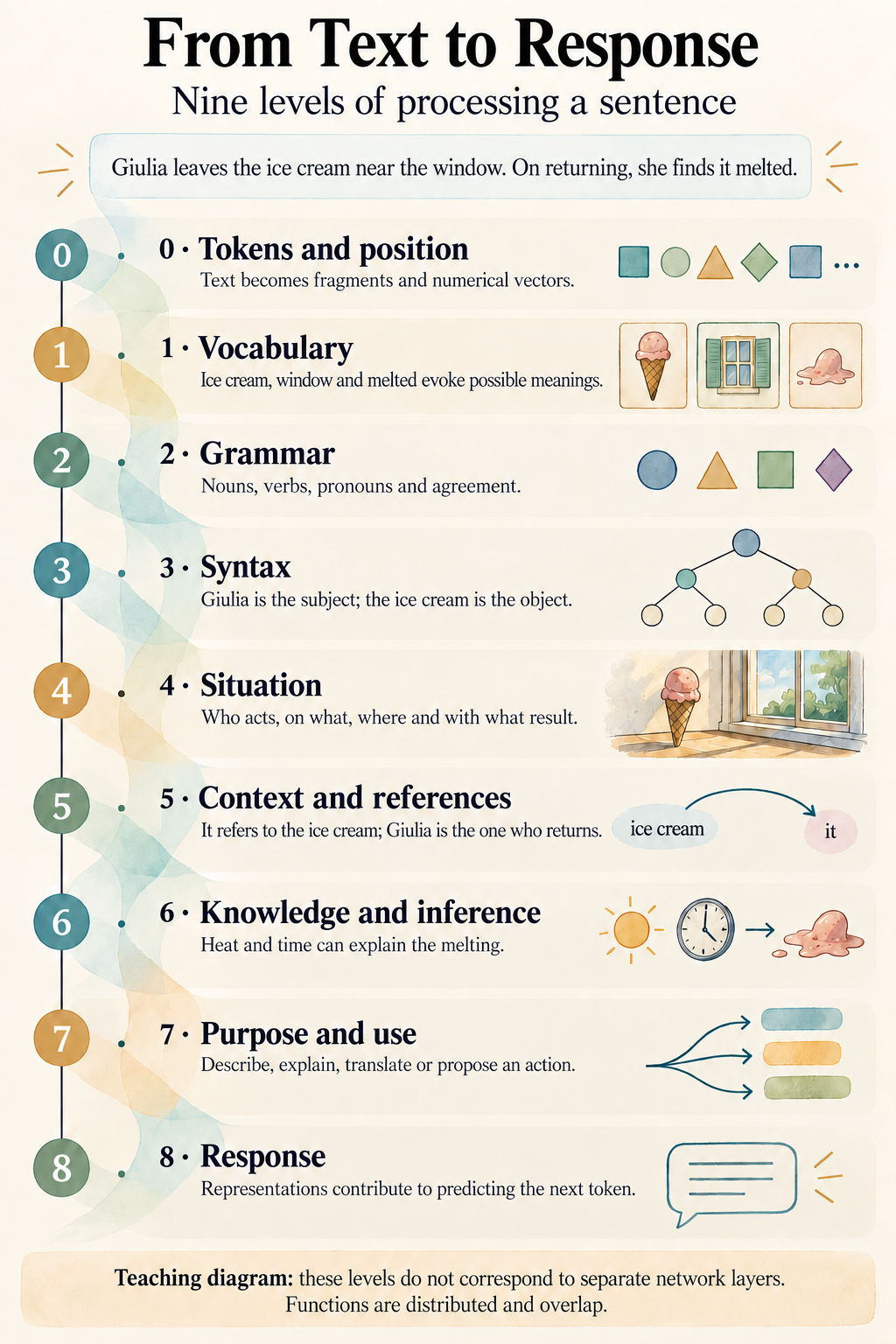
The intuitive progression is:
units of text → sentence structure → situation described → contextual connections → inferences → response
In the network, however, this information overlaps and is transformed across several layers.
The network’s layers progressively transform information, combining it in different ways. There is no simple division in which the first layers contain words and the last contain intelligence: functions are distributed and interact.
The interesting point is that meaning can become useful for prediction. To anticipate what will be said, it may help to represent what is being discussed.
From this perspective, statistics and semantics describe connected aspects of the same process: the criterion by which the system is trained and some of the structures it can learn.
What does “emergence” mean?
This is where the word emergence often appears.
A property is emergent when it arises from the organisation and interaction of many components, without being recognisable in any single isolated component. One network parameter does not translate a sentence; a suitably trained network can.

The term nevertheless requires precision. “Emergent” does not necessarily mean sudden, inexplicable or conscious. It indicates a level of description at which the capabilities of the system as a whole become visible.
The next question concerns the use of these capabilities. A representation can support comparisons, inferences and the evaluation of alternatives. We can then also think of intelligence as the ability to operate on representations: to connect them, correct them and use them to address new problems.
But what happens when the system itself appears among the things being represented?
Self-reference: from Gödel to Hofstadter
Self-reference has an important history in logic.
Kurt Gödel’s incompleteness theorems show the limits of consistent, effectively axiomatised formal systems sufficiently expressive to handle arithmetic. Gödel’s construction makes it possible to formulate a statement that, through an encoding, concerns its own provability within the system.
These results do not demonstrate machine consciousness. What matters for our discussion is the role of self-reference: a formal language can come to express statements about the system in which they are formulated. (Stanford Encyclopedia of Philosophy, Gödel’s Incompleteness Theorems.)
Douglas Hofstadter brought this theme into reflection on the mind, especially in Gödel, Escher, Bach and I Am a Strange Loop. His “strange loop” describes a movement between levels of representation that eventually returns to itself.
In the case of the mind, this perspective invites us to think of the self as a structure that forms when a system represents the world and includes itself within that representation.
It is a philosophical proposal to be debated. It does not constitute proof that a language model capable of self-reference has subjective experience. But it certainly comes very close.
The hypothesis: meaning that turns back on itself
We can now formulate a hypothesis.
A system learns relationships between signs. These relationships support representations of concepts and situations. More elaborate representations can support models of an environment, the actors inhabiting it and the consequences of their actions.
The system itself might appear among those actors: its role, the information it can access, its limitations and the effects of its responses.
The map thus begins to contain the cartographer too.

This path is neither an inevitable sequence nor a proven law of the development of artificial intelligence. It is a way of posing a question: could a sufficiently rich self-model, capable of influencing the system’s behaviour, be one of the ingredients of something resembling a self?
Describing one’s own functioning, monitoring an error and having an inner experience are different abilities. The first does not guarantee the second; neither, on its own, demonstrates the third.
The open question concerns precisely the relationship between these levels.
From prediction to the question of the self
We began with a simple objective: predicting the next fragment of text. We arrived at the possibility that, to perform that task well, a system builds representations of relationships, situations and points of view.
How rich these representations need to be, and what forms they may take, remains a question to investigate. The passage from self-representation to subjective experience also remains a hypothesis, not an established conclusion.
Yet the problem deserves to be formulated.
Saying that a machine uses statistics describes its learning mechanism. To understand its capabilities, we must also investigate what that mechanism allows it to represent and how it uses those representations.
We have built systems that learn to predict language. Language speaks about the world, other people and ourselves.
If a machine learns to represent these relationships and comes to include its own role within its map, what is still missing for that representation to become a self?
Perhaps today’s most fruitful question begins precisely here: understanding what distinguishes a machine capable of describing itself from a subject for whom there is something it is like to exist.